
Spectres of Law
Author: Bahar Banaei
August 8, 2026
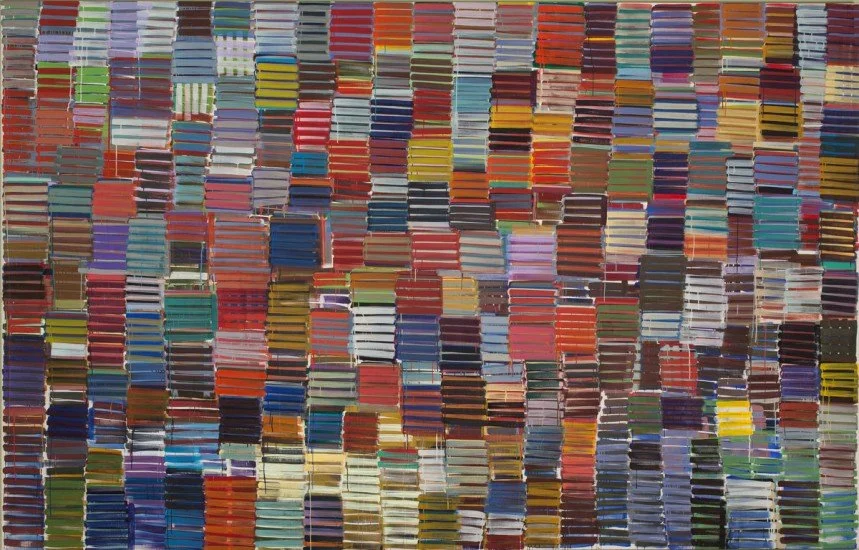
Rally (1994) Denyse Thomasos
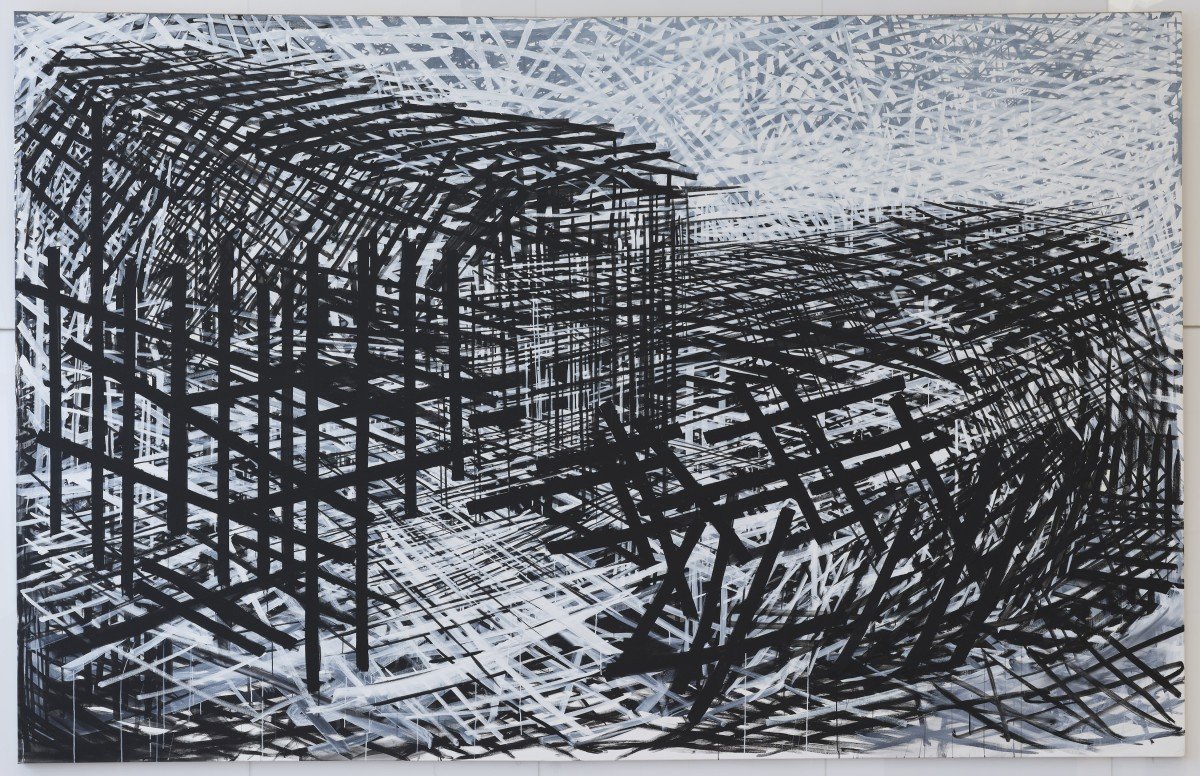
Dos Amigos (Slave Boat) (1993) Denyse Thomasos
The law giveth and the law taketh away. The law kills and the law resurrects. Legal practice conflates symbolic control and the inscription of that control on real bodies. If the natural creature possessed of personal status dies not to be reborn in the spirit but in the body of civil society, what kind of body is this?
— Colin Dayan, The Law is a White Dog
In December 2022, members of the Collaborative for Racial Justice (CRJ) visited the career retrospective of Trinidadian-Canadian artist, Denyse Thomasos (1964-2012), at the Art Gallery of Ontario. The exhibit’s focal point was the towering, large-scale, acrylic paintings that abstractly represent scenes such as the industrial port, the city centre, and the slave ship in angular, broad strokes. The work reveals the contours of structural and racial violence that construct the landscapes we inhabit daily, however, the subjects who are made and unmade through these spaces are absent from the images. Instead, her work represents paradoxical spaces that are simultaneously ghost towns and bustling cities; crowded and abandoned slave ships. There is a spectral presence in the work where the figure is absent yet overwhelmingly haunts the landscape. Nearly four years after our visit I am still left thinking about her work. I wonder: Where is the subject within the overwhelming architecture of violence? Where is the law?
The reflections that emerged from the Thomasos exhibit complement ongoing conversations we have been having as a collaborative over the years. In our reading groups we have read works by scholars such as Anthony Farley (“Perfecting Slavery”), Saidiya Hartman (Scenes of Subjection), Avery Gordon (Ghostly Matters), Colin Dayan(The Law is a White Dog), and Walter Benjamin (“Critique of Violence”). These texts inform broader questions about what the law is and how it is continuously transforming, how the law informs and signifies culture, how subjects are made by and structure the law; and how the law seduces us into a promise of jurisprudential order and equity while manufacturing violence. Thus, in our reading group we have been concerned with the aporias inherent to racial violence and the law.
In an interview about her work, Thomasos states, “I recognize that my interest in imprisonment in the outside world actually stems from my own feelings of isolation and the ways I have had to survive that.” I take this as a provocation to think about ‘imprisonment in the outside world’ and how a violent total institution such as the prison simultaneously exists within and outside of itself. Scholars such as Agamben and Derrida have long taught us to not think of such counterparts as opposites at all. Rather, seemingly opposing concepts such as ‘law’ and ‘violence’ or ‘slavery’ and ‘freedom’ require one another and exist through one another. This approach therefore challenges the normative legal idea that one is a remedy to the other; rather, they are co-constitutive forces. As Orlando Patterson states in the conclusion of Slavery and Social Death, “without slavery there would have been no freedmen” (Patterson 1982, 342). The promulgation of laws such as the Emancipation Proclamation work to preserve the notion of binary opposition, in that the law operates as an advancement from racial violence and not as its necessary requirement. However, what is left unsaid in the law after legislation has been passed and decisions have been made, is new psychic and cultural forms of the repetition of violence. It is in the afterlife of legal doctrine, upheld by the rule of law, in which violence continues “perfecting” itself (Farley 2005).
Liberal democracies have long upheld the notion that the rule of law protects us from tyranny and “power’s all intrusive claims” (Thompson 1975, 266). We are currently witnessing the rapid collapse of this myth. The rapid intensification of putative fascism and racial violence has shored up new discourses around the erasure, destabilization, and crisis of the rule of law. The Trump administration’s extra-legal kidnapping of Nicolás Maduro, ongoing support for the genocide in Palestine, illegal strikes on Iran, and the intensification of the offshore detention of migrants are examples of this. In the Canadian context, there has also been a swift abandonment of the perceived commitment to international law as Prime Minister Mark Carney vacillatesbetween stating the war on Iran “appears to be against international law” while in the same breath supporting military action. Such decisions by political leaders have created a ‘crisis’ amongst legal scholars around the ‘end of the law’ as we know it. However, this supposed ‘collapse’ of the law must be understood as sine qua non of the liberal jurisprudential order. Power is created and maintained by reaching into the extra-judicial realm in order to exercise law-making and law-preserving violence (Benjamin 1986). Even when the law has seemingly been abandoned, it still haunts, through legal culture, language, and memory. Thus, this spectral presence has the power to make and unmake persons, dispossess lives, and construct a nomos.
Spectres of Law Symposium
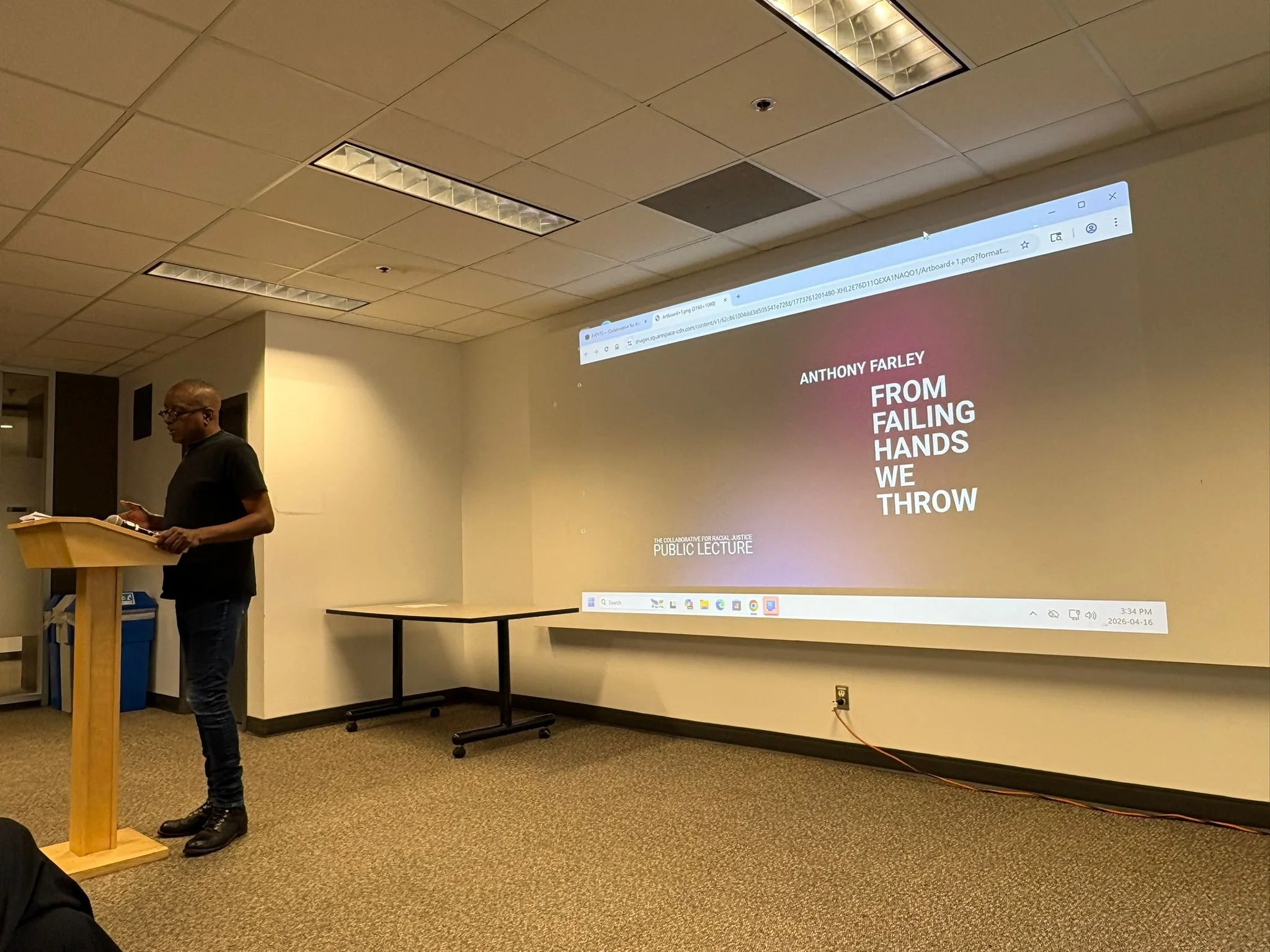
Anthony Farley, York University, April 16, 2026
On April 16, 2026, the CRJ convened a group of scholars at York University to explore these ideas under the theme of ‘spectres of law.’ The symposium was organized by myself, Carmela Murdocca, Brianna Garneau, Sanjida Salman, Marcelle-Anne Fletcher, and Patrick Teed. To interrogate the spectres of law is to interrogate normative conceptions of the law. It is to attend to the lacuna that exists between the formal stipulation and broader tentacles of the law. Attending to this haunting space allows us to consider the ways in which the seeming ‘crisis’ of the legal order within liberal democracies is not a crisis at all, but a familiar resurgence of racial violence. To consider the spectre is to consider Orlando Patterson’s submission that liberal democracies are the “most articulate defender[s] of [freedom]” yet also the epicenters of the injustices of slavery (Patterson 1982, ix).
Our group consisted of professors and doctoral students who discussed their work in relation to the theme. The conversation was framed around the following questions: How does law remain operative through suspension, absence, and spectral presence in contexts of racial violence? How does the spectre of law operate in ostensibly lawless or extra-legal spaces such as the border, prison ship, the detention centre, or camps? How can literature, film, and art help us to apprehend these spectral operations of law?
The second half of the symposium was a public lecture which began with a poetry reading by Furqan Mohamed and was followed by an exciting keynote lecture by Professor Anthony Farley, James Campbell Matthews Distinguished Professor of Jurisprudence at Albany Law School. The keynote lecture, titled “From Failing Hands We Throw” was an insightful address on the haunting violence of the modern era from primitive accumulation to the present legal order. Invoking an array of thinkers such as William Shakespeare, Arthur Schopenhauer, Karl Marx, E.E. Cummings, and Gertrude Stein, Farley takes to task the challenge of considering how the racial violence of the law haunts through ostensibly innocuous means. Such haunting does not present itself explicitly, rather, “the ghost appears because we are forbidden to think the thought” (Farley 2026). The talk began with a reading of John McCrae’s prominent and revered Canadian ode to the First World War, “In Flanders Fields.” I have been reflecting on Farley’s use of McCrae’s poem and thinking about how the text is a call to the author to pass the torch of war from “failing hands,” and how the form of the poem as it is produced and reproduced, manufactures unconscious consent in the continuation of violence. Farley’s engagement with such texts reveals how the literary form can act as a call to the reader at the psychic, unconscious level to pass the torch and engage in the repetition of violence. The expansive form of his lecture was a captivating method of illustrating the reaches of “world-spanning violence.”
At the CRJ we continue thinking through this theme and have collected a reading list that will act as a living document. If you are interested in reading alongside us and think about questions of haunting, the law, and racial violence, you’re welcome to access the document here.
Cited:
Benjamin, Walter. 1986. “Critique of Violence.” In Reflections: Essays, Aphorisms, Autobiographical Writings. New York, NY: Schocken Books.
Farley, Anthony P. 2005. “Perfecting Slavery.” Loyola University Chicago Law Journal 36 (1): 225–56.
Patterson, Orlando. 1982. Slavery and Social Death: A Comparative Study. Cambridge, MA: Harvard University Press.
Thompson, EP. 1975. “Rule of Law ‘an Unqualified Human Good?’” In Whigs and Hunters: The Origin of the Black Act. New York, NY: Pantheon Books.