
Bahar Banaei’s research receives the St. George's Society of Toronto Endowment for Graduate Student Award (2026-2027).
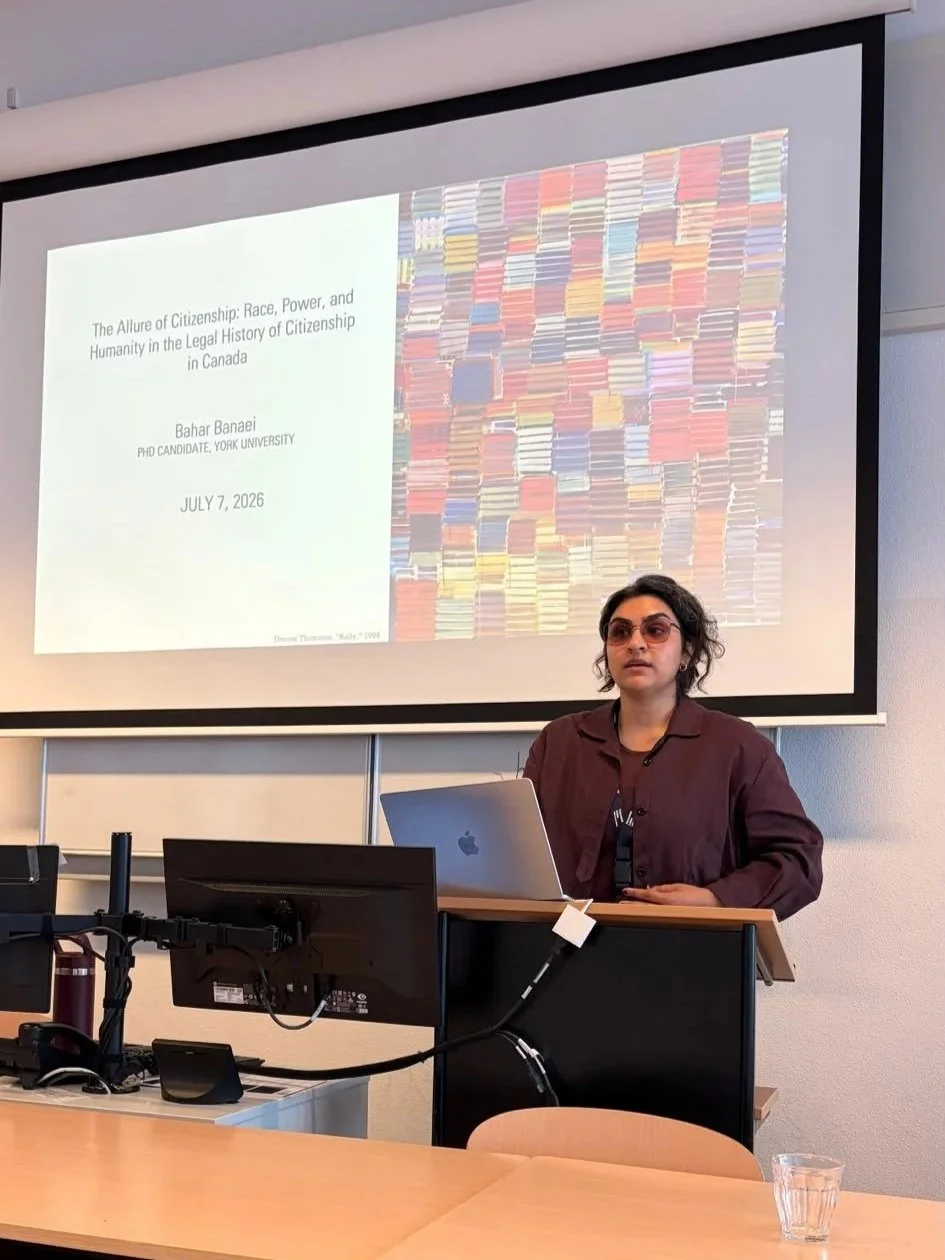
This award seeks to “support graduate students with areas of research pertaining to British culture.”
About Bahar’s research:
“In my dissertation, I conduct historical, race critical, and socio-legal research that attends to the intimacies between the British Empire and Canada between the late 19th century and early 20th century. I focus on the period between the Canadian Confederation (1867) and the establishment of Canada’s first Citizenship Act (1947) to trace how the concept of ‘citizenship’ was conceptualized in relation to racialized migration from the United States at the time of the emerging nation-state of Canada.
After Confederation, Canada was attempting to solidify its national identity through political, economic, and moral objectives as well as defining who its citizen-subjects were. At this point, citizen-subjects were not just a reflection of the British colonial metropole, but of the nascent Canadian nation-state. Questions of racial equity were also highly present at this time as white Canadians tried to reconcile liberal equal rights doctrine (which was central to British liberal jurisprudential logic) with racially exclusionary migration policies.
In the late 19th and early 20th centuries, hundreds of thousands of farmers migrated from the U.S. to settle in the Prairie provinces. Despite claims of legal equality, not all migrants were welcome. Black farmers fleeing the rise of Jim Crow in the U.S. were met with resistance and hostility by white Canadians. In my dissertation, I conduct archival research of newspaper articles and Parliamentary debates from the time of the Great Plains migration to examine how anti-Black and racially exclusionary rhetoric was circulating in tandem with discussions of what it means to be ‘Canadian’ in the Dominion of Canada wherein ‘citizens’ were still British subjects. My research speaks to the mandate of the St. George’s Society as I critically and carefully investigate the role of the British Empire’s laws and cultural production on Canada’s developing immigration and citizenship laws after Confederation.”